
Inclusive City
through Integrated Content
At the core of icontentic is the idea of integrated content, which refers to bringing together different forms of knowledge, experience, and perspectives to create a more complete understanding of an inclusive city. Through this portal, I intend to explain how an inclusive city can be imagined and implemented, prioritizing equality and justice as a right of citizenship, rather than categorizing forms of individual difference, especially cultural diversity. Categorizing people based on factors such as gender, race, sexual status, and ethnicity, while sometimes useful for study, can fuel social divisions and undermine cohesion.
Meanwhile, digitalization, along with the growing potential of artificial intelligence for personalization, offers new opportunities to rethink inclusion and reduce discrimination, both in its negative and positive forms.
Content Integration
The existing literature on content integration across disciplines refers to the use of multicultural content, multidisciplinary curricula, or multimedia to present content.
Integrated content is a result of combining insights from multiple disciplines. Fields such as psychology, social science, demographic studies, marketing, and information technology each contribute unique perspectives and knowledge. When these disciplines are brought together, they create a more holistic and comprehensive understanding of complex societal issues. This integration allows for the development of content, policies, and solutions that are more responsive to diverse human needs, supporting inclusive and well-informed decision-making.
By integrating these aspects, content becomes more responsive, inclusive, and grounded in reality. It allows for a deeper engagement with complexity and avoids oversimplified or one-dimensional interpretations
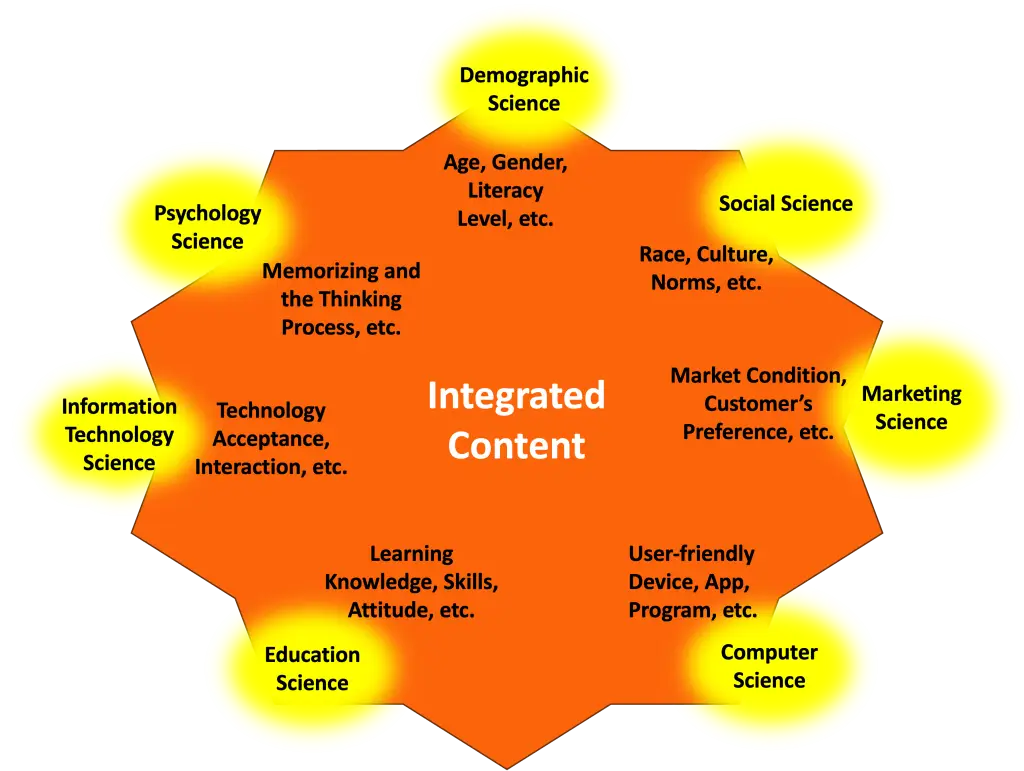
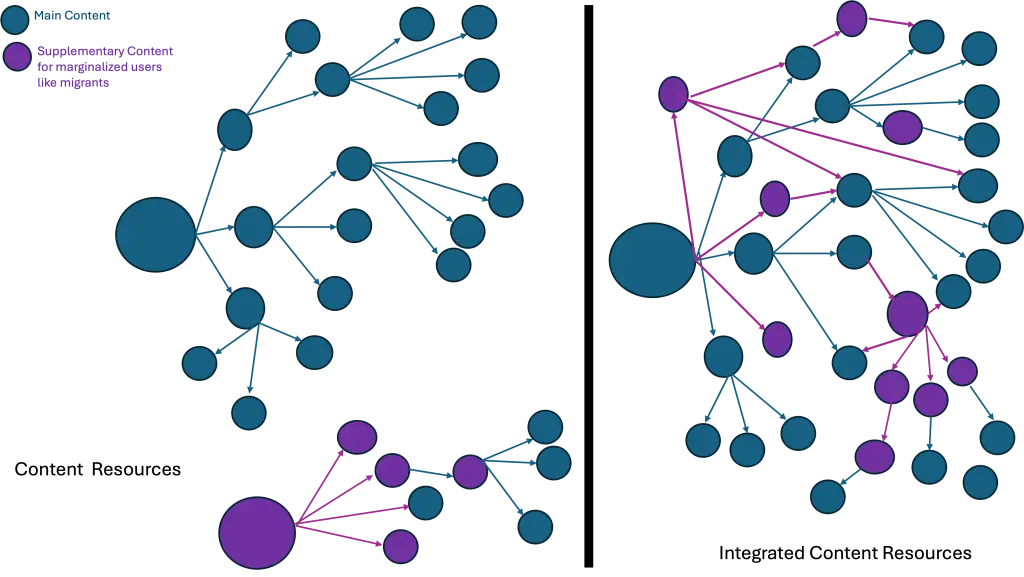
This diagram (Fig. 3) shows integrated content at the level of structuring the goal analysis.
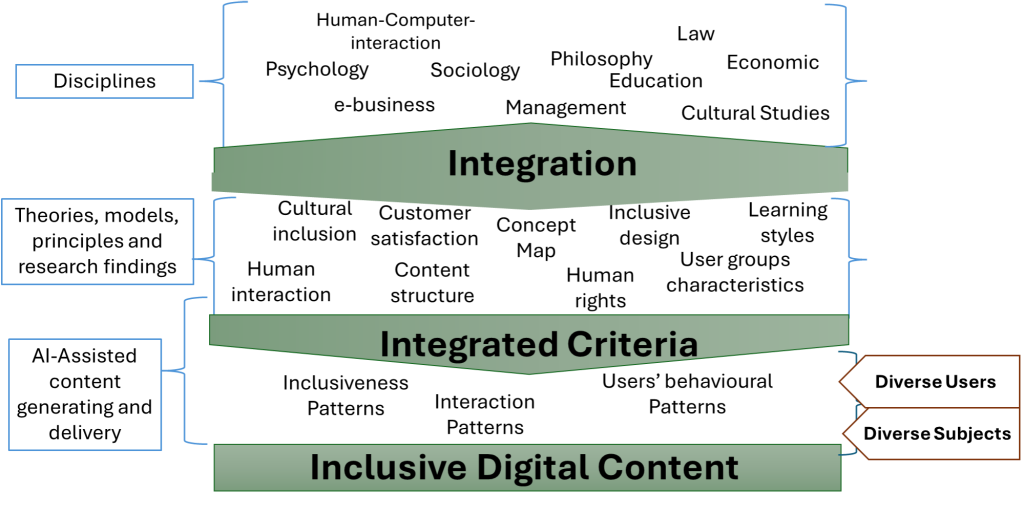
Diagram 3 shows the process of content integration at the level of disciplines to the level of digital content.
What is Inclusivity
Inclusivity is the practice of creating environments, policies, and attitudes that ensure all individuals feel equally valued, respected, and empowered to participate. It goes beyond merely having diverse representation by actively removing barriers so that people of all backgrounds, abilities, and identities have fair access to opportunities.
From Integration to Inclusion: Rethinking Policy in Multicultural Societies
As societies become increasingly multicultural, the way we think about social cohesion and policy design must evolve. For many years, policymakers have focused heavily on integration, especially in the early stages of migrants’ arrival. Integration programs typically aim to help newcomers adapt to the host society through language training, employment support, and basic orientation to social systems. These efforts are essential, particularly during the first year of settlement, as they provide the foundation for participation in society.
However, integration alone is not sufficient for building long-term belonging or cohesive communities.
The visual above illustrates an important shift: while integration often treats people as members of specific groups—categorized by culture, ethnicity, or other identity markers—it can unintentionally lead to parallel lives, in which communities coexist yet remain socially distant. This creates a risk: people may be physically present in the same society, yet feel disconnected from it and from one another.
This is where inclusivity becomes critical.
Inclusion as the Next Step
Inclusion goes beyond group-based integration. Traditionally, integration policies have focused on empowering minority groups, ensuring representation, protecting rights, and addressing inequalities. While this remains important, the growing complexity of multicultural societies calls for a broader and more nuanced approach.
Today, inclusion must be understood at the individual level. Rather than seeing people only through the lens of group identity (e.g., migrant, gender, religion, disability), policymakers need to create environments where each individual has equal access to opportunities, participation, and recognition, regardless of their background, gender, race, sexual orientation, physical ability, or belief system.
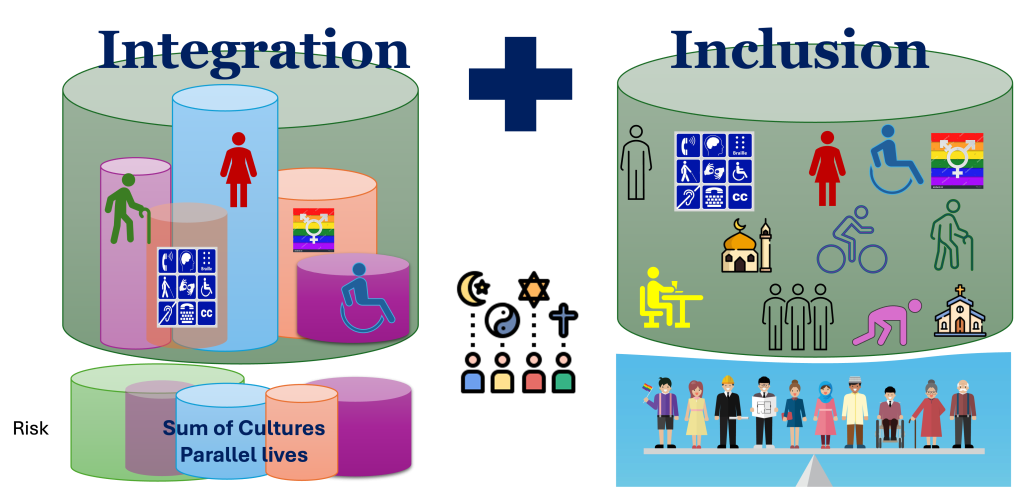
From “Groups” to “People”: Broading the Concept of Citizens
As shown on the Fig 1, this idea reflects: inclusion is not about separating people into categories, but about bringing diverse individuals into a shared social space where differences are acknowledged but do not limit participation.
An inclusive society:
- Enables equal access to education, employment, and services
- Recognizes diverse needs without isolating individuals into fixed categories
- Supports continuous participation beyond initial integration phases
- Fosters a genuine sense of belonging
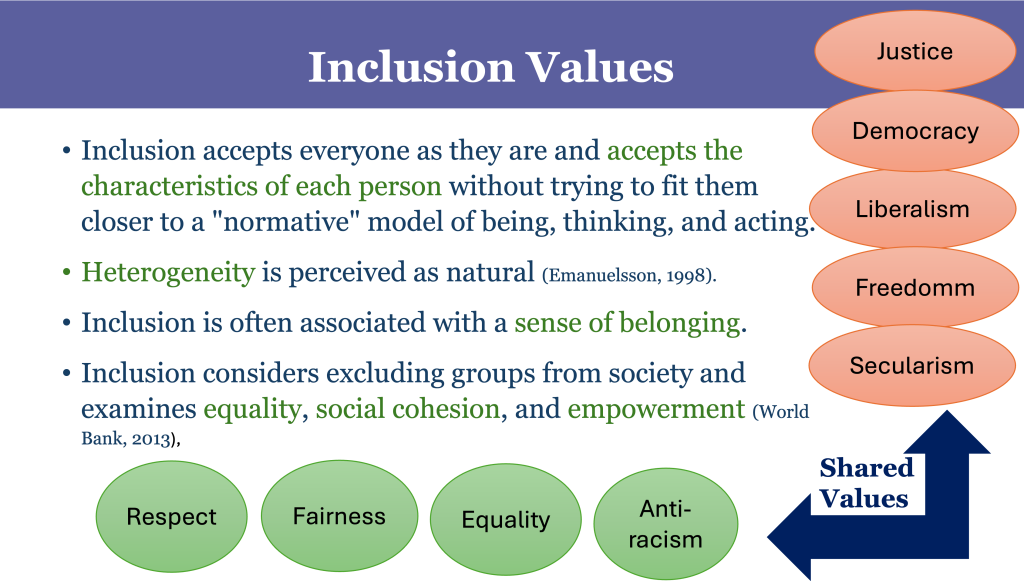
Cultural inclusion is closely linked to broader societal goals such as equality, social cohesion, and empowerment. It acknowledges that exclusion can occur structurally, and therefore, inclusion must intentionally address barriers that prevent participation. At the foundation of inclusive practice are everyday values, respect, fairness, equality, and anti-racism, which guide interactions, policies, and institutional behavior.
Cultural inclusion helps individuals to be connected to shared societal values such as justice, democracy, freedom, liberalism, and secularism. These act as the normative framework within which inclusion operates, ensuring that diversity is balanced with common principles that hold society together. In this way, inclusion is not only a social ideal but also a value-driven approach to building cohesive, fair, and democratic communities.
Cultural inclusion can be defined as accepting individuals as they are, recognizing and valuing their unique characteristics without forcing them to conform to a single “normative” way of being. Diversity, therefore, is not treated as a problem to manage, but as a natural and essential feature of society (as Fig 2 shows). This perspective shifts the focus from merely accommodating differences to actively fostering a sense of belonging, where individuals feel seen, respected, and able to participate fully.
Why This Shift Matters
Without inclusion, integration efforts risk being temporary. Individuals may learn the language and find jobs, but still feel excluded from social, cultural, or civic life. This weakens social cohesion and can lead to fragmentation over time.
In contrast, inclusion:
- Strengthens long-term connection to society
- Encourages interaction across differences
- Builds trust between individuals and institutions
- Supports resilient, cohesive communities
Policy Implications
For policymakers, this means a shift in focus:
- From short-term integration programs → to long-term inclusive environments
- From group-based interventions → to individual-centered opportunities
- From coexistence → to meaningful participation and belonging
In practical terms, policies should aim to design systems, education, healthcare, urban spaces, and labor markets that are flexible and responsive to diverse individual needs, rather than assuming uniform experiences within groups.
To design an inclusive portal, it is essential to draw on theories and methods from multiple disciplines, such as social sciences, psychology, and technology. Combining these perspectives enables the creation of integrated content that reflects diverse user needs and experiences. However, to ensure quality and trustworthiness, this content must be carefully classified and validated using reliable and authorized sources.